

Every RFP that lands on your desk represents a potential project for your firm. It also represents hours of work for your marketing team, technical staff, and principals before you know whether you’ll win it.
For architecture and engineering firms, that time adds up quickly. Between preparing qualifications, coordinating with project managers, developing the technical approach, and assembling the final proposal, even a relatively straightforward pursuit can consume significant resources.
Before committing to another proposal, it’s worth evaluating your relationship with the client, your experience with similar projects, the competition, and your team’s available resources.
A go no go decision gives your firm a consistent way to assess those factors before the proposal work begins.
In this article, we’ll cover what to include in a go/no-go evaluation, how to score opportunities, and how to use Deltek Vantagepoint CRM to manage the process.
What Is a Go/No-Go Decision in A&E Business Development?

A go/no-go decision is a structured evaluation that helps an architecture or engineering firm decide whether to pursue a business opportunity.
The firm evaluates the opportunity against agreed-upon criteria, typically including client relationships, relevant experience, competitive position, project profitability, and available resources.
Consider an engineering firm reviewing an RFP for a $2 million municipal infrastructure project. The contract value looks attractive, and the team has completed similar work. However, the incumbent has held the contract for 15 years, the firm has no established relationship with the municipality, and the proposal is due in ten days.
A formal go/no-go review gives the team a chance to weigh those concerns before committing resources to the proposal.
Declining an RFP can be a reasonable business decision. As Engineering Inc. points out in its discussion of RFP FOMO, A&E firms can spend considerable time and money pursuing projects they have little chance of winning. A consistent evaluation process helps your team make more deliberate decisions about where those resources go.
A Practical Go/No-Go Scoring Matrix for A&E Firms
A go/no-go scoring matrix gives your firm a consistent way to evaluate potential projects before committing proposal resources.
For A&E firms, this typically involves scoring opportunities based on client relationships, relevant experience, competitive position, profitability, and staff availability.
One approach is to rate each criterion from 1 to 5, with 1 representing a poor fit and 5 representing a strong fit. You can also assign weights based on your firm’s priorities.
Here’s what a sample evaluation might look like:
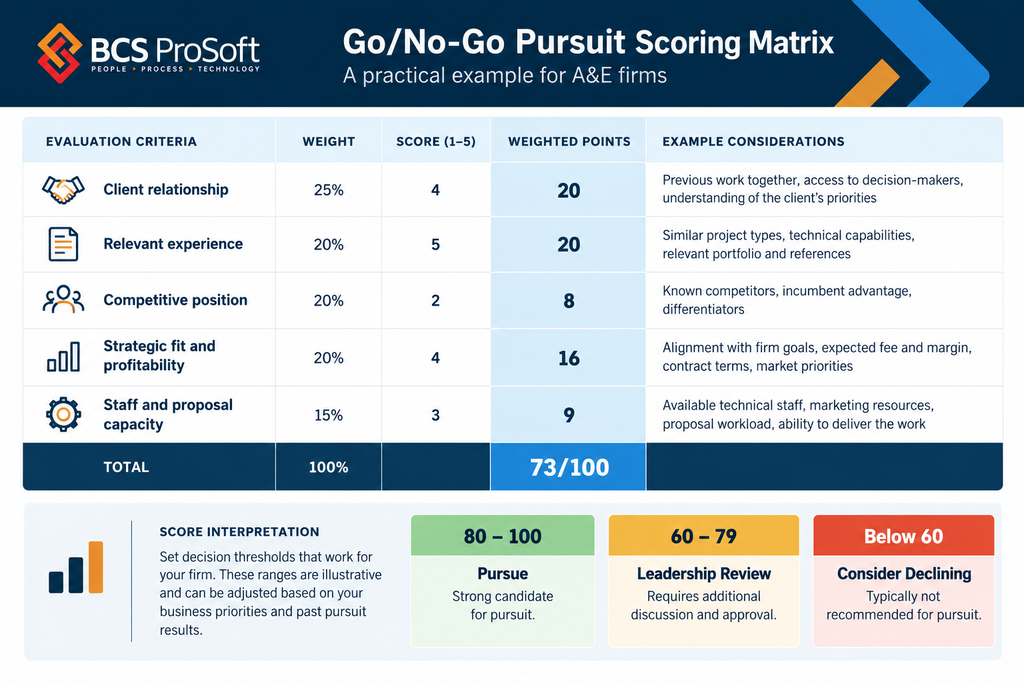
Each weighted score is calculated by dividing the rating by 5 and multiplying it by the criterion’s weight in points.
In this example, the opportunity receives 73 out of 100 possible points.
Your firm could establish decision thresholds such as:
- 80–100: Strong candidate for pursuit.
- 60–79: Requires additional leadership review.
- Below 60: Generally recommend declining.
These are illustrative thresholds that should be adjusted based on your firm’s priorities and previous pursuit results.
Leadership should also consider circumstances the scoring model may not fully capture. An opportunity with a high score could carry unacceptable contractual risk, while a lower-scoring project might warrant consideration because of its strategic importance.
You may also want to establish conditions that require leadership review regardless of the total score, such as insufficient licensing, unavailable key staff, or contract terms your firm cannot accept.
Document the reasoning behind the final decision, particularly when leadership chooses to override the score.
What Should A&E Firms Score Before Pursuing an RFP?
The five criteria in the scoring matrix provide a starting point for evaluating opportunities. However, the weight assigned to each one will depend on your firm’s business development priorities.
Here’s what to consider when evaluating each factor.
Client Relationship and Access
Your relationship with the prospective client should carry considerable weight in the evaluation.
Consider your firm’s history with the client, how well you understand their expectations, and whether you’ve had meaningful contact with the people responsible for selecting the winning proposal.
An established relationship can provide valuable insight into the client’s priorities and how they evaluate competing firms.
If the first time you’re hearing about a project is when the public RFP arrives, you may have limited information about what the client wants or how your firm compares with the competition.
Relevant Project Experience
Relevant experience affects how convincingly your firm can demonstrate its qualifications.
Evaluate the project type, size, complexity, geographic location, and technical requirements against your completed work.
Your team should also consider whether it has the project examples, references, and qualified personnel needed to submit a competitive proposal.
For an architecture firm with extensive K-12 experience, another school district project may be a strong fit. A specialized healthcare facility could require a different level of experience and technical expertise.
Competitive Position
Your firm’s chances of winning depend partly on who else is pursuing the project.
You may be competing against an incumbent, a firm with stronger local relationships, or a company with more experience in the client’s industry.
Consider your competitive advantages and how much you know about the other firms involved.
If your team has limited information about the competition, document that uncertainty as part of the evaluation.
Project Profitability and Strategic Fit
Contract value deserves consideration, along with the expected fee, anticipated margins, contractual requirements, and potential delivery risks.
You’ll also want to evaluate how the project aligns with your firm’s target markets and business development priorities.
A lower-margin project may still be attractive if it helps establish a relationship with a strategic client. Leadership should understand the financial implications before making that decision.
Staff Availability and Proposal Resources
Staff availability affects both the proposal and the firm’s ability to deliver the project.
Review your marketing team’s existing proposal commitments, the availability of technical leads, and whether you have qualified project management staff to support the work.
Three overlapping proposal deadlines may leave little room for a fourth submission, especially when the same technical employees are needed for each one.
How to Manage Go/No-Go Decisions in Deltek Vantagepoint CRM

Now that we’ve covered how to score potential opportunities, let’s look at how you can manage that process in Deltek Vantagepoint CRM.
Vantagepoint brings together much of the information your business development team needs to make a go/no-go decision, including client relationships, project details, estimated fees, and pursuit stages. With the right configuration, you can use that information to support a consistent evaluation process and keep track of decisions within your CRM.
So, how would you put this into practice at your firm? Let’s walk through the process step by step, from setting up an opportunity to reviewing your scores and tracking the results.
1. Capture the Opportunity Before Scoring It
Start by opening the opportunity record in Vantagepoint and reviewing the information already available.
Your BD team should confirm that the record includes the prospective client, project type, estimated fee, proposal deadline, and employees responsible for the pursuit.
Review the associated client and contact information as well. Previous project history and recorded interactions can help the team assess the relationship before assigning a score.
If information is missing, have the appropriate BD or project team member update the record before the evaluation meeting.
For firms with several offices or practice areas, using consistent opportunity data also helps leadership compare pursuits across the organization.
2. Set Up Your Evaluation Criteria
Vantagepoint allows firms to create user-defined fields to capture information beyond standard opportunity details.
Your team could configure fields for the five scoring criteria discussed earlier:
- Client relationship strength
- Relevant project experience
- Competitive position
- Strategic fit and project profitability
- Staff and proposal capacity
Each field could use an agreed-upon rating scale, such as 1 through 5.
With the appropriate workflow configuration, Vantagepoint can calculate a weighted score using the values entered. This requires defining the calculation rules and how the result will be recorded.
For example, your configured process could classify opportunities into three categories: Go, Go with Management Approval, or No Go.
Your BD team would enter the ratings in the opportunity record, and the workflow could calculate the result using your established scoring formula.
Before rolling this out across the firm, test the configuration with several previous opportunities. Compare the calculated scores with the actual decisions and outcomes to see whether the weighting reflects how your firm evaluates pursuits.
3. Record the Decision and Who Approved It
Once the evaluation is complete, the final decision should be recorded in the opportunity record.
Consider including fields for the decision status, approval date, reviewer, and any supporting notes.
This becomes particularly useful when a principal approves a pursuit that falls below your firm’s normal scoring threshold.
For example, leadership may approve an opportunity because it supports expansion into an important regional market. Recording that explanation helps your team understand why the decision was made when reviewing the opportunity later.
Depending on your setup, Vantagepoint workflows can also support notifications or additional review requirements when an opportunity needs management approval.
The specific approval process should reflect who has authority to make pursuit decisions at your firm.
4. Review Pursuit Priorities Alongside Your Pipeline
Once evaluations are recorded consistently, your BD team can use that information during regular pipeline meetings.
Consider setting up a report or saved view that brings together approved pursuits, opportunities awaiting review, and upcoming proposal deadlines.
Depending on your configuration, you may be able to include the go/no-go score, estimated fee, opportunity stage, responsible employee, and proposal due date.
This gives marketing directors and BD leaders a practical way to review what is coming up and where resources have already been committed.
Vantagepoint also supports configurable opportunity stages, so your firm can establish how declined pursuits should be identified and tracked.
5. Compare Your Scores With Actual Pursuit Outcomes
As your firm records more pursuit decisions, you can begin comparing the original evaluations with the projects you ultimately win or lose.
Use Vantagepoint reporting to review opportunity outcomes alongside the scoring information captured in your configured fields.
Look for patterns in the criteria.
You may find that your firm wins more frequently when it has an established client relationship, or that opportunities with strong technical qualifications still perform poorly against certain incumbents. Win rates and pursuit outcomes are among the business development KPIs worth reviewing as you evaluate how well your scoring criteria reflect actual results.
Those findings can help your leadership team reconsider how much weight each factor receives.
You can also review decisions that were approved despite lower scores to understand whether those exceptions produced worthwhile opportunities.
How BCS ProSoft Can Help You Get More From Vantagepoint CRM

If your firm is managing pursuit evaluations through spreadsheets, emails, and separate approval processes, it may be worth reviewing how those activities could be handled within Vantagepoint.
Much of the opportunity information needed for a go/no-go evaluation may already exist in your CRM. The next consideration is how to configure the scoring fields, calculations, and review process around the way your firm manages business development.
At BCS ProSoft, we work with architecture and engineering firms to configure Deltek Vantagepoint, improve CRM reporting, and support business processes.
We can review your current opportunity management setup, identify where additional fields or workflows may be useful, and help configure Vantagepoint to support your pursuit evaluation process.
If you’re considering adding go/no-go scoring to Vantagepoint or want to improve how your firm manages opportunities, we’d be happy to discuss your options.
Talk to BCS ProSoft About Deltek Vantagepoint
Final Thoughts
A formal go/no-go process gives your firm a consistent way to evaluate which opportunities deserve a proposal investment. Your scoring criteria should reflect how your firm evaluates client relationships, competition, profitability, and available resources.
If you’re already using Deltek Vantagepoint, much of the information needed for these evaluations may be available in your CRM. With the right configuration, you can incorporate pursuit scoring into your existing business development process and maintain a record of the decisions your team makes.
As you collect more data on pursuit outcomes, revisit your scoring criteria and adjust them based on your firm’s actual win/loss results.
Key Takeaways
- A go/no-go decision helps A&E firms evaluate opportunities before committing proposal resources. Reviewing potential projects against established criteria helps teams decide which pursuits deserve their time and attention.
- Client relationships, relevant experience, competitive position, profitability, and staff availability should influence pursuit decisions. These five factors provide a practical starting point for evaluating RFPs.
- A weighted scoring matrix helps firms evaluate opportunities consistently. Assigning scores and establishing decision thresholds gives leadership a clearer basis for approving or declining pursuits.
- Deltek Vantagepoint CRM can support go/no-go evaluations through configuration. User-defined fields, workflows, and reporting can help firms calculate scores, document approvals, and manage pursuit information.
- Reviewing win/loss results helps firms improve their scoring criteria. Comparing original pursuit evaluations with actual outcomes can reveal which factors have the greatest influence on winning projects.
Frequently Asked Questions
What is a go/no-go decision in business development?
A go/no-go decision is a formal evaluation that helps a firm determine whether to pursue a potential business opportunity. In architecture and engineering, this typically involves assessing client relationships, project experience, competitive position, profitability, and available resources before committing time and money to an RFP response.
How do you calculate a go/no-go score for an A&E proposal?
Start by assigning weights to your evaluation criteria based on their importance to your firm. Rate each criterion on a scale of 1 to 5, divide the rating by 5, and multiply it by the assigned weight in points. Add the weighted scores to calculate a total out of 100.
Your firm can then establish thresholds for approving pursuits, requiring leadership review, or declining opportunities.
Can Deltek Vantagepoint track go/no-go decisions?
Yes. Deltek Vantagepoint CRM can be configured to support go/no-go evaluations using user-defined fields, scoring calculations, and workflows. Firms can record evaluation criteria, calculate weighted scores, document approval decisions, and use reporting to review pursuit outcomes. The specific capabilities available depend on your Vantagepoint configuration.
Who should participate in an A&E firm’s go/no-go review?
Most firms benefit from including business development, marketing, project management, and firm leadership in the review. BD and marketing can assess client relationships, competition, and proposal requirements, while project managers evaluate technical qualifications and staff availability. Leadership typically makes the final pursuit decision.c
How often should A&E firms review their go/no-go scoring criteria?
An annual review is a reasonable starting point, although firms may need to revisit their criteria sooner when entering new markets or changing business development priorities. Comparing pursuit scores with actual win/loss results can help identify which criteria or weights need adjustment.