

A private equity portfolio can look organized from the outside and still be messy behind the scenes.
Each portfolio company may have its own accounting system, chart of accounts, close process, approval structure, and reporting habits. That may be manageable early on. It gets harder after the second add-on acquisition, the third reporting deadline, or the first time leadership needs clean numbers across every entity before the finance team has finished stitching the data together.
That is the point where private equity accounting software becomes more than a back-office decision.
For private equity-backed companies, the system has to support portfolio-wide reporting, multi-entity consolidation, ownership-based roll-ups, fund-level views, and faster add-on acquisition onboarding. The goal is to give finance a cleaner way to move from company-level activity to investor-ready reporting without rebuilding the package every month.
Sage Intacct is built for that kind of finance environment. With multi-entity accounting, continuous consolidation, dimensional reporting, and advanced ownership support, it gives portfolio finance teams a stronger foundation for close, reporting, and growth.
Why Portfolio Accounting Breaks Down Across Private Equity-Backed Companies

Portfolio accounting usually breaks down when the portfolio view depends on too much translation after month-end.
Each company may close its books accurately, but the parent finance team still has to convert that activity into a shared reporting structure. That means aligning charts of accounts, ownership treatment, intercompany activity, reporting dimensions, and close status before leadership can trust the consolidated view.
The work gets harder as the portfolio changes. A new add-on may bring a different chart of accounts. A minority investment may require different ownership treatment. A platform company may need reporting by department, location, customer, or acquisition cohort. Investors may need fund-level visibility that the operating companies do not track on their own.
When the accounting system cannot carry that structure, finance fills the gap with exports, mapping files, consolidation workbooks, and manual adjustments.
That creates problems such as:
- Slow portfolio roll-ups after month-end
- Inconsistent reporting across acquired entities
- Manual intercompany cleanup
- Limited visibility by fund, company, department, location, or acquisition cohort
- Investor reporting delays
- More rework when late changes come in
- Less confidence in the audit trail behind consolidation adjustments
Spreadsheets may help finance get through a reporting cycle, but they become risky when they carry recurring work like ownership logic, account mapping, intercompany eliminations, or investor reporting. At that point, portfolio reporting depends on manual files instead of a financial system designed for the job.
That is why private equity-backed companies need accounting software that can support the portfolio structure itself, not only the books of each individual company.
For a deeper look at the reporting side of this challenge, BCS ProSoft also covers the topic in its guide to multi-entity reporting.
What Private Equity Accounting Software Has to Handle

In a private equity-backed environment, the general ledger has to support reporting across entities, ownership structures, acquisitions, funds, and stakeholders.
The system should help finance answer questions like:
- What did each portfolio company close?
- What changed after consolidation?
- Which entities are included in each roll-up?
- Which entities are partially owned?
- Which add-on acquisitions are still being integrated?
- Which reporting dimensions matter for leadership?
- Which numbers are ready for investor reporting?
That requires five core capabilities:
Multi-Entity Accounting
Each company needs its own books, users, permissions, and financial statements. The parent finance team also needs a portfolio view across those companies.
Multi-entity accounting lets finance keep the company-level detail intact while still supporting consolidated reporting.
Continuous Consolidation
Manual consolidation slows down when finance has to export reports, map accounts, check formulas, post eliminations, and rerun the file after late changes.
Continuous consolidation helps finance review results with more consistency during the reporting cycle instead of waiting for a disconnected workbook to be rebuilt.
Ownership-Based Reporting Logic
Private equity structures often include controlled entities, minority positions, advanced ownership trees, and ASC 810-related reporting considerations.
The software needs to support the approved reporting structure as entities are added, sold, combined, or restructured.
Dimensional Reporting
Finance needs to report by the categories leadership actually uses, such as company, entity, fund, department, location, acquisition cohort, customer, or project.
A strong dimension structure helps the firm view the same financial data from different angles without creating separate versions of the reporting package.
Repeatable Acquisition Onboarding
Each add-on should enter the platform through a process that finance can use again.
That process should cover entity setup, chart mapping, opening balances, ownership method, close tasks, approvals, integrations, and reporting packages.
This is why private equity-backed companies often outgrow small-business accounting tools and legacy systems. The accounting system may still support one company, while the reporting model starts to strain under the weight of the full portfolio.
Add-On Acquisition Onboarding Checklist for Private Equity Finance Teams
Add-on acquisitions are one of the biggest stress tests for private equity accounting software.
PitchBook’s 2025 Global PE Report reported that add-ons accounted for nearly 74% of all private equity deal activity in North America. For buy-and-build firms, acquisition onboarding is a recurring finance workflow, not a one-time integration project.
The deal may close legally, but the accounting work is far from finished. Finance still has to bring the new company into the portfolio’s reporting structure, close calendar, consolidation process, and investor reporting package.
A practical onboarding process should cover five areas.
1. Set Up the New Entity
Finance needs to create the new company in the accounting system with the correct legal entity, base currency, tax profile, reporting calendar, and ownership structure.
This step gives the acquired company a clean place inside the portfolio structure instead of leaving it disconnected from the parent company’s reporting process.
2. Map the Financial Data
The acquired company’s chart of accounts needs to be mapped to the parent or portfolio reporting structure. Finance also needs to bring in opening balances, retained earnings, debt schedules, and any starting intercompany balances.
This is where a lot of first-close cleanup happens. If the mapping is weak, the roll-up will not be reliable.
3. Apply Reporting Dimensions
The new company needs the right reporting tags, such as portfolio company, legal entity, fund, department, location, product line, project, or acquisition cohort.
These dimensions help leadership view performance from the right angles without creating separate spreadsheets for every reporting request.
4. Confirm Consolidation and Intercompany Treatment
Finance needs to confirm how the acquired company should roll up into the portfolio. That may involve full consolidation, equity method reporting, proportional treatment where applicable, or advanced ownership logic.
The team also needs to account for shared services, management fees, loans, allocations, reimbursements, and eliminations.
This step matters because ownership and intercompany activity can quickly create reporting errors if they are handled manually.
5. Connect Close, Controls, and Reporting
The acquired company should be added to the close calendar, approval workflows, user permissions, audit trail, dashboards, and reporting package.
Finance should also confirm which systems need to connect to the accounting platform, such as payroll, CRM, billing, expense management, banks, or operational systems.
The goal is to make the new company part of the normal reporting cadence as quickly as possible.
If every acquisition requires a new workaround, portfolio reporting becomes fragile. A repeatable onboarding model gives finance a cleaner way to bring new companies into the close and reporting process with less manual cleanup.s parts of that process, especially when the portfolio includes partial ownership, minority interests, or multi-level structures.
How Sage Intacct Supports Private Equity Portfolio Accounting
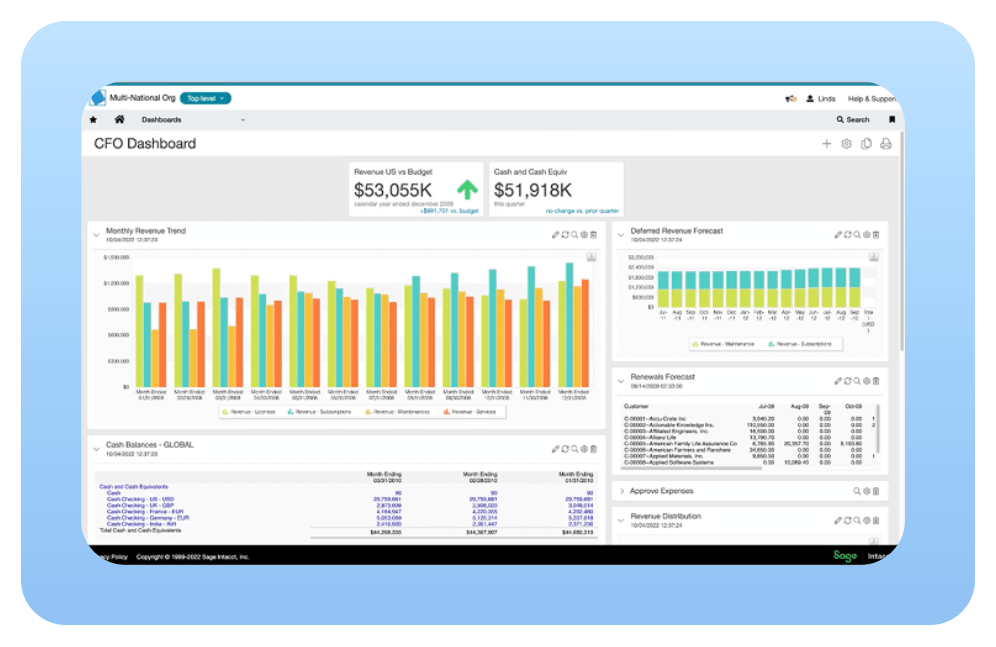
The add-on checklist shows what has to happen when a new company enters the portfolio. The larger question is whether the accounting system can support that same structure every month after onboarding is complete.
Finance still has to close entity-level books, roll results into the portfolio view, track intercompany activity, apply reporting dimensions, manage approvals, and prepare investor-ready reports. If those steps depend on exports and manual workbooks, the portfolio becomes harder to manage with every acquisition.
Sage Intacct helps private equity-backed companies bring that work into one financial management platform, so new and existing portfolio companies can follow a more consistent accounting, consolidation, close, and reporting process.
Multi-Entity Accounting for Portfolio Companies
Each portfolio company can maintain its own books, users, permissions, and financial statements. The parent finance team can roll up results across entities and view performance across the portfolio.
That gives finance a cleaner path from company-level activity to consolidated reporting. It also helps the firm keep entity-level accounting intact while giving leadership the portfolio view it needs.
Continuous Roll-Ups for Faster Reporting
Manual consolidation slows down when finance has to export reports, map accounts, check formulas, post eliminations, and rerun the file after late changes.
Sage Intacct helps finance manage roll-ups inside the financial system. Entity-level books can feed consolidated views, and leadership can review results with more consistency during the reporting cycle.
That matters because month-end close is the starting point for board reporting, investor updates, lender reporting, operating reviews, and acquisition decisions.
Dimensional Reporting for Different Stakeholder Views
Dimensional reporting is especially useful in a private equity-backed environment.
Instead of forcing every reporting need into the chart of accounts, finance can tag transactions by the categories leadership uses to review performance. That may include company, entity, fund, department, location, acquisition cohort, customer, project, or revenue type.
This matters because each stakeholder usually needs a different view of the same financial data.
The CFO may need consolidated financials. The operating partner may want company-level performance by location or business unit. The board may want EBITDA and cash reporting. Investors may need fund-level visibility. The platform company may need department-level reporting.
A well-designed Sage Intacct structure allows those views to come from the same source data rather than separate spreadsheet versions.
Close Management That Supports Investor Reporting
Different close timelines, messy intercompany balances, inconsistent mappings, and manual files all slow the path from entity-level accounting to investor-ready reporting.
Sage Intacct gives finance a way to manage more of that work inside the system through close calendars, entity-level task ownership, recurring entries, intercompany transaction support, approval workflows, audit trails, consolidation reporting, and dashboards.
For private equity-backed companies, the close is the starting point for investor reporting, board decks, lender updates, operating reviews, and acquisition analysis. A slow close compresses every reporting step that follows.
That is why private equity accounting software should be evaluated based on the full reporting timeline. The real question is how quickly finance can move from entity-level activity to consolidated reporting that leadership can trust.
BCS ProSoft covers related close evaluation criteria in its guide to financial close software.
Add-On Reporting After Close
The first 30 to 60 days after an acquisition usually reveal whether the onboarding work was complete.
Finance has to confirm opening balances, account mapping, dimensions, approvals, intercompany visibility, and upstream system feeds before the new company can become part of the standard reporting cadence.
Sage Intacct can help bring the acquired company into the same close calendars, reporting packages, dashboards, approval workflows, and consolidation structures used across the rest of the portfolio.
That gives private equity finance teams a repeatable model for buy-and-build growth. The first acquisition may require heavier design work. The next acquisition can follow the same structure with adjustments for entity-specific needs.
At that stage, recurring accounting and reporting work can stay inside Sage Intacct, where the portfolio’s entity structure, dimensions, approvals, and consolidation logic already live.
When to Evaluate Sage Intacct with BCS ProSoft
The best time to evaluate Sage Intacct is usually when portfolio reporting starts depending on workarounds.
Common buying triggers include:
- Multiple portfolio companies or legal entities are being consolidated manually
- Add-on acquisitions are creating reporting cleanup
- Investor reporting depends on spreadsheets and exports
- Ownership structures are getting harder to maintain
- Leadership cannot easily view performance by company, entity, fund, or acquisition cohort
Sage Intacct has the structure to support that kind of portfolio finance environment, and implementation quality matters. Private equity firms and private equity-backed companies need the system configured around their entity structure, ownership model, reporting needs, and close process.
BCS ProSoft helps firms evaluate and configure Sage Intacct across areas such as entity structure, fund and portfolio reporting dimensions, chart of accounts design, consolidation setup, advanced ownership requirements, intercompany workflows, approval paths, close management, reporting packages, dashboards, add-on acquisition onboarding, integrations, and user permissions.
The goal is to make Sage Intacct match the way the firm reports, reviews, adds companies, and communicates performance to stakeholders.
A leading private equity firm reduced its close time by 40% across five portfolio companies after implementing Sage Intacct. Improved reporting accuracy and timeliness also supported a 25% increase in capital commitments for one private equity firm.
For portfolio finance teams, those gains come from better structure. The system carries the recurring work, and finance gets more time to review performance, explain variance, support acquisitions, and prepare investor, lender, board, and management reporting.
Conclusion: Private Equity Accounting Software Should Support the Portfolio Operating Model

Private equity finance teams need a system that can support portfolio-company accounting, multi-entity consolidation, ownership-based reporting, dimensional roll-ups, faster close cycles, and add-on acquisition onboarding.
Sage Intacct gives private equity-backed companies a financial management platform designed for that kind of structure. With continuous multi-entity consolidation, advanced ownership capabilities, dimensional reporting, and flexible entity setup, finance teams can reduce manual roll-up work and build a reporting process that can grow with the portfolio.
BCS ProSoft helps private equity firms and private equity-backed companies evaluate, configure, and implement Sage Intacct around the way their portfolio operates.
To see how Sage Intacct can support your portfolio accounting, consolidation, and add-on acquisition reporting process, visit BCS ProSoft’s private equity accounting software page.
Key Takeaways
- Private equity accounting software should support multi-entity consolidation, dimensional reporting, ownership structures, and add-on acquisition onboarding.
- Fragmented ledgers across portfolio companies create roll-up delays, investor reporting pressure, and close-cycle rework.
- Sage Intacct supports private equity-backed companies with multi-entity accounting, continuous consolidation, dimensional reporting, and advanced ownership capabilities.
- Add-on acquisitions need a repeatable onboarding process that covers entity setup, chart mapping, opening balances, dimensions, approvals, and reporting packages.
- BCS ProSoft helps private equity firms configure Sage Intacct around portfolio-level, entity-level, and fund-level reporting needs.
Frequently Asked Questions
What is the best accounting software for private equity firms?
The best option is usually a private equity software system that can support entity-level accounting, ownership-based consolidation, and reporting across portfolio companies. For firms evaluating Sage Intacct, the value comes from using one accounting engine for multi ledger management, detailed financial statement reporting, management company accounting, and partnership accounting. Sage Intacct can also act as fund accounting software when the implementation includes fund accounting needs such as entity structure, ownership tracking, and reporting by fund, company, and investor.
How does Sage Intacct help with private equity portfolio reporting?
Sage Intacct helps finance teams bring portfolio data into one reporting structure so leadership can review performance without waiting on disconnected workbooks. This supports portfolio monitoring, portfolio management, integrated data management, data management, consistent reporting, comprehensive reporting, and real time visibility across entities, funds, departments, locations, acquisition cohorts, and operating companies.
Can Sage Intacct support add-on acquisitions?
Yes. Sage Intacct can support add-on acquisition onboarding by helping finance create the new entity, map the chart of accounts, import opening balances, apply reporting dimensions, set approvals, and add the company to the close process. For private equity operations, this gives finance a repeatable structure for investor onboarding, pipeline management, process automation, and post-close reporting after each acquisition.
Does Sage Intacct support ASC 810 consolidation needs?
Sage Intacct can support consolidation structures that align with ASC 810 reporting needs, including controlled entities, partial ownership, and advanced ownership structures. The finance team should still work with its CPA or audit advisor on technical accounting conclusions. The system gives fund managers a way to manage ownership logic, capital activity, cash flows, and reporting across multiple funds with stronger data security and secure access.
What consolidation methods matter for private equity-backed companies?
Private equity-backed companies may need full consolidation, equity method reporting, proportional treatment where applicable, and advanced ownership roll-ups for complex entity structures. The right method depends on control, ownership percentage, reporting requirements, and accounting guidance. This is especially important for a private equity fund with alternative asset classes, capital calls, and investor level reporting needs.
Why do private equity-backed companies move away from QuickBooks or legacy accounting systems?
Private equity-backed companies often move away from QuickBooks or legacy systems when manual reporting starts slowing the quarter end reporting cycle. As firms grow, complex processes around cash management, investor management, investor relations, investor communication, and reporting across portfolio companies become harder to manage through spreadsheets and exports.
How can BCS ProSoft help with Sage Intacct for private equity?
BCS ProSoft helps pe firms evaluate and configure Sage Intacct around the way their private equity platform operates. That can include entity structure, dimensional reporting, ownership setup, close management, integrations, approval paths, and reporting packages. In the private equity industry, this work matters because investor relations professionals need accurate reporting, operational efficiency, and a finance system that enables firms to support stakeholders with less manual cleanup.