

If you are responsible for payroll, project oversight, or day-to-day operations, there is a good chance you have dealt with late timesheets more times than you would like to admit. It does not matter whether your firm relies on paper time sheets, spreadsheets, or modern time tracking software. At some point, someone forgets. Someone submits late. Someone logs the wrong hours worked.
When this happens occasionally, it feels manageable. When it happens every pay period, it starts to affect payroll processing, client billing, and confidence in your numbers.
What makes this situation frustrating is that most employees are not trying to cause problems. In many cases, employees forget because the time tracking process does not fit naturally into their workday. Others are unsure how many hours to log, how to record overtime hours, or where time spent should go.
In this blog, we will look at how to get employees to submit timesheets on time by examining why late submissions happen and what actually helps teams stay consistent.
Why Employees Struggle to Submit Timesheets on Time

Even firms with strong policies and a clear employee handbook run into this issue. The challenge is usually operational, not disciplinary. Here are some common reasons why employees struggle with timesheets:
Employees forget when time tracking feels disconnected
When time tracking feels separate from actual work, it becomes easier to postpone. Employees move from meetings to deliverables to client work, and time sheets become something to deal with later. Forgotten timesheets pile up, and reconstructing actual hours becomes harder with each passing day.
This is especially common when employees submit timesheets only at the end of the pay period instead of logging hours closer to when work happens. By that point, people are often relying on calendars or memory to estimate how many hours they worked, which rarely leads to accurate records.
Unclear expectations create hesitation
When employees are not sure about the timesheet deadline, the due date, or how strictly expectations are enforced, submission becomes inconsistent. Some employees submit timesheets on time every cycle. Others wait until they are reminded. Over time, the entire team develops mixed habits.
Managers often recognize this pattern quickly. A small group always submits on time. Another group submits late every pay period. Everyone else falls somewhere in between, depending on workload and urgency.
Manual systems invite human error
Paper time sheets, disconnected tools, and manual entry increase the likelihood of human error. Missing hours, incorrect work hours, invoice discrepancies, and confusion around how many hours were worked become common when the process relies on memory instead of structure.
Why Late Timesheets Become a Business Issue
When employees fail to submit timesheets on time, payroll teams face a familiar choice. Either payroll is delayed, or hours worked are estimated so employees can be paid. Both options introduce risk. Delays damage trust. Estimates increase the chance that employees are not paid accurately.
As this becomes routine, the effects spread. Reporting relies on incomplete data. Managers plan work without a clear view of employee hours. Decisions around resource assignment become harder because current workload and availability are uncertain.
This is often the point where firms start asking a deeper question about control, responsibility, and risk.
Addressing Compliance Without Creating Conflict
Employers often ask what they are allowed to do when an employee fails to submit a timesheet. Labor laws make this area sensitive.
Employers are legally obligated to maintain accurate records of employee hours. Under the Fair Labor Standards Act, employers must pay earned wages on time, including overtime pay for non-exempt employees. An employer cannot withhold pay or delay payment simply because a timesheet was submitted late.
That responsibility sits with the employer regardless of the submission issue. Employees must still be paid correctly, minimum wage requirements must be met, and accurate payroll records must be maintained.
At the same time, late timesheet submissions do not have to be ignored. Repeated failures to follow the submission process can still be addressed through documented disciplinary action, as long as payroll obligations are met. Separating pay from performance management helps firms remain compliant while maintaining accountability.
This clarity matters before moving forward. It sets boundaries around what can and cannot be enforced.
What a More Reliable Timesheet Process Feels Like

When time tracking works well, it fades into the background. Employees submit timesheets on time because the process fits into how they already work.
A more stable approach usually includes:
- Clear expectations for when employees submit timesheets each pay period
- A consistent submission process across hourly employees and salaried employees
- Early visibility into employee hours before payroll runs
- Fewer surprises tied to missing timesheets or forgotten timesheets
In these environments, managers are not spending Fridays chasing time sheets, and payroll teams are not scrambling to reconstruct actual hours at the last minute.
Where Automation Actually Helps
Automation in time tracking focuses on reducing unnecessary steps in the submission process, so logging hours fits naturally into daily work.
In practice, automation supports timesheet submission by:
- Presenting employees with assigned projects and tasks when they log time, preventing cost overrun
- Reinforcing the timesheet deadline through system-based rules
- Sending automatic reminders that prompt timely submissions
- Giving managers visibility into late employee timesheets before the next pay period
With a structured time tracking system in place, employees submit time closer to when the work happens. That leads to more accurate time records, fewer corrections, and fewer downstream timesheet errors.
At this point, time tracking starts to feel like part of the workflow rather than a separate task employees have to remember.
How Deltek Replicon Supports Timely Timesheets
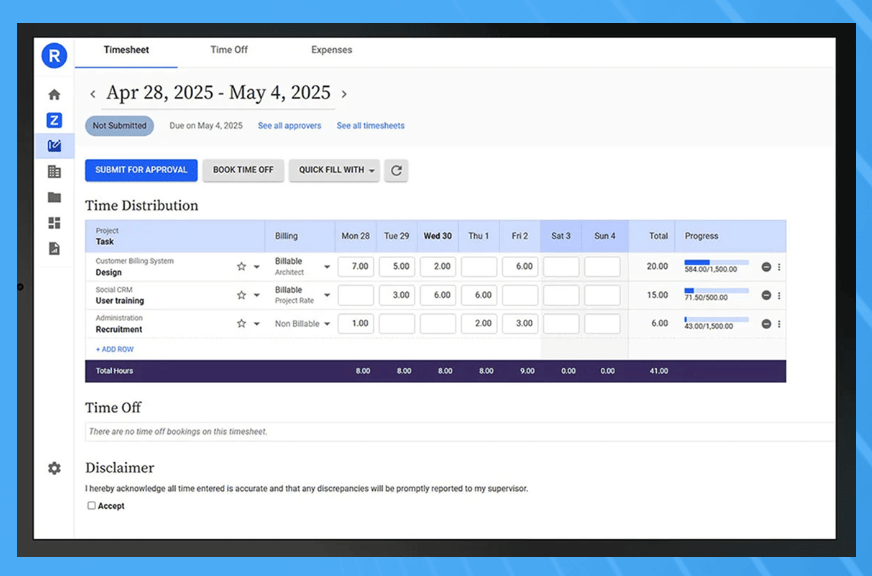
Deltek Replicon is designed to support consistent time tracking across the entire team by focusing on the moment where hours are recorded.
Employees log hours against active projects and assignments, which reduces confusion about where hours worked belong. Built-in workflows reinforce timesheet submission expectations without relying on constant follow-up.
For managers and payroll teams, Replicon provides visibility into time sheets before payroll or invoice processing begins. That visibility supports accurate records, reduces late timesheets, and makes payroll more predictable.
Because Replicon sits close to daily work, it supports both hourly workers and salaried employees without forcing them to rethink how they track their time.
How BCS ProSoft Helps Firms Get More Value From Replicon
Deltek Replicon works best when it reflects how work actually happens inside the organization. Configuration plays a major role in whether employees submit timesheets on time or continue to struggle with late timesheet submissions.
BCS ProSoft helps firms configure Replicon so the time tracking system aligns with real projects, real work hours, and existing approval practices. The focus stays on adoption and usability rather than forcing teams to adapt to rigid structures.
That alignment supports better project management, clearer project tracking, and fewer downstream issues tied to reporting and billing.
Conclusion: How to Get Employees to Submit Timesheets on Time

When employees submit timesheets on time consistently, the shift is noticeable.
Payroll teams spend less time fixing issues from the prior pay period. Managers gain clearer insight into actual hours and project progress. Teams have fewer conversations about missing hours, late timesheets, or last-minute corrections.
Most importantly, employees are paid accurately and on time. That reliability builds trust across the entire team and removes a recurring source of tension.
If your team is still spending too much time chasing time sheets or correcting entries at the end of each pay period, BCS ProSoft can help you align Deltek Replicon with the way your projects and approvals actually work, so your time tracking system supports consistent submission without constant follow-up. Contact us today to learn more.
Key Takeaways
- Late timesheets are usually the result of workflow gaps, unclear expectations, or time tracking processes that do not align with daily work.
- Employees are more likely to submit timesheets on time when the submission process is consistent, predictable, and tied directly to their actual projects and tasks.
- Employers remain responsible for paying earned wages and maintaining accurate payroll records, even when timesheets are submitted late.
- Automation supports timely timesheet submission by reducing unnecessary steps, reinforcing deadlines, and improving visibility before each pay period.
- Deltek Replicon helps teams capture hours worked closer to when work happens, which reduces corrections and improves reliability across payroll and reporting.
Frequently Asked Questions
What should employers do when employees submit timesheets late?
Employers should first review whether the time tracking process itself is contributing to late submissions. Clear expectations, consistent deadlines, and a structured submission process help reduce late timesheets. Repeated issues can be addressed through documented disciplinary action, as long as payroll obligations are still met.
Can an employer withhold pay if an employee does not submit a timesheet?
No. Employers are legally obligated to pay earned wages for hours worked, even if a timesheet is missing or submitted late. Withholding pay or delaying payment can create compliance risks under labor laws, including the Fair Labor Standards Act.
How does automation help employees submit timesheets on time?
Automation helps by reducing unnecessary steps in the submission process and reinforcing deadlines through system-based rules. When employees see assigned projects, receive reminders, and submit time within a consistent structure, timely timesheet submission becomes easier to maintain.
Does time tracking software work for both hourly and salaried employees?
Yes. A well-configured time tracking system supports both hourly workers and salaried employees by aligning time entry with actual work hours, projects, and approval workflows. The goal is consistency and accuracy across the entire team.
What causes employees to forget to submit timesheets?
Employees often forget when time tracking feels disconnected from their daily work or when expectations are unclear. Manual processes, paper time sheets, and inconsistent enforcement also contribute to forgotten timesheets.
How can firms reduce repeated late timesheet submissions?
Reducing repeated late submissions usually requires changes to the system rather than stricter reminders. Clear deadlines, visible expectations, and a time tracking tool that supports daily habits help teams stay consistent over time.