
If you’re in manufacturing, you know accounting gets complicated quickly. It goes far beyond tracking invoices and vendor payments. You’re dealing with raw materials that sit in staging for weeks, labor that changes with every shift, and production runs that fall apart when someone enters the wrong BOM.
Your financials need to reflect what’s actually happening on the floor. Not just the planned version, but the real-world version with delays, scrap, and last-minute changes.
Many manufacturing companies struggle here. The numbers look fine in the system, but they don’t hold up under pressure. Inventory valuation might seem accurate until the year-end audit. Job costing only works until a batch needs rework. ERP systems generate standard costs that no one on the floor can verify.
This post breaks down accounting for manufacturing, where the biggest issues tend to show up, and how Sage Intacct and Sage 100 can help you stay grounded in real, usable financial data.
Manufacturing Accounting 101: How It Differs From Traditional Bookkeeping

Traditional bookkeeping tracks income and expenses. Most of the work happens after the fact. You close the books, reconcile the accounts, and run the reports.
Manufacturing accounting works differently. You have to follow the flow of production while it’s happening. That means tracking raw materials, direct materials, direct labor, indirect costs, and manufacturing overhead as they move through the plant. Work-in-progress needs to be valued. Finished goods need to be costed accurately. Every step in the production process affects your financials.
There are more moving parts. You’re dealing with fluctuating labor, shifting material costs, and overhead that changes depending on volume. You need costing methods that can handle this kind of variability. Most manufacturing companies use standard costing, actual costs, weighted average cost, or activity-based costing. Each feeds into inventory valuation, cost of goods manufactured, and cost of goods sold.
Your reports also rely on good data from inventory records, job travelers, and production schedules. If those numbers are off, your financial statements won’t reflect what actually happened. Manufacturing accounting requires constant input, not just end-of-month adjustments.
This is why most manufacturing companies use dedicated manufacturing accounting software. It handles the day-to-day complexity and helps keep cost flow assumptions, cost pools, and production costs tied to the real work happening on the floor.
Top Accounting Challenges in a Production Environment

Accounting in a production environment rarely follows a clean line. Even with solid systems in place, issues tend to pile up as production schedules shift, labor changes hands, and materials move without perfect records. Most of these challenges are ongoing. They don’t show up once a year. They happen every day, right alongside the work. Let’s take a look at them:
Inventory valuation is rarely straightforward.
Whether you use FIFO, LIFO, or weighted average cost, the method needs to line up with how materials actually move through your facility. If pricing changes mid-month or you’re pulling from multiple lots, the numbers in the system might not reflect what’s happening on the floor. That disconnect affects your total manufacturing cost and has an impact on taxes, margins, and reporting accuracy.
Job costing is only as good as the data going in.
Production teams are busy. Time clocks, job travelers, and shift logs often miss details. If someone forgets to record time or uses materials without logging them, those direct costs disappear. Labor and overhead might get dumped into general categories, which makes it hard to see which jobs are profitable and which are not.
Overhead allocation often feels like guesswork.
Cost pools for utilities, maintenance, and indirect labor can stretch across multiple product lines. Assigning those overhead costs evenly doesn’t always reflect real usage. When overhead is spread too broadly, unit costs can drift out of range, and profitability by product becomes hard to trust.
Multi-entity and multi-plant setups increase complexity.
Manufacturing companies with more than one plant or legal entity deal with inconsistent data structures. Different plants may follow different costing methods, naming conventions, or system setups. Pulling consolidated reports takes extra work, and small differences in setup can lead to bigger issues during month-end close.
Production data often lags behind the actual work.
If scrap is recorded late or labor hours are updated after the job is closed, financial reports end up out of sync. Real-time decisions based on delayed inputs create gaps that are hard to clean up later. Even small delays in recording can shift reported costs in ways that affect margin tracking.
Standard costs drift when no one updates them.
Standard costing is useful when it reflects current conditions. If material prices or labor rates change but the standards stay fixed, your reports lose relevance. Variance reports start to show swings that are difficult to explain, and teams stop trusting the numbers. Learn more about this with our blog on cost accounting for manufacturing.
Fixed and variable costs both need attention.
Direct labor and raw materials are easier to track than things like overtime, machine downtime, or facility rent. When variable costs increase without explanation or fixed costs are misallocated, the overall picture becomes harder to manage. Each type of cost needs to be reviewed regularly to keep reporting accurate.
Periodic inventory systems create blind spots.
Inventory counts that happen once a month or once a quarter often miss short-term swings. If materials are pulled early or transferred between locations without tracking, those records are never updated. The longer the delay between updates, the more likely it is that inventory valuation reports will be off.
Unplanned events create reporting gaps.
Scrap, rework, and material substitutions happen often. When they do, they need to be captured quickly and tied to the right job. If they are missed or logged elsewhere, the original cost plan becomes inaccurate. That makes it harder to measure actual costs, and harder to explain variances when they show up.
Manual fixes create long-term problems.
When systems don’t match the way work happens, people create their own solutions. Spreadsheets, sticky notes, or workarounds might solve the issue short term, but they pull information away from your main records. Over time, this creates reporting issues that are harder to track down and clean up.
These challenges don’t always show up in the same place, but they tend to repeat. Teams that stay close to the details and review their accounting process regularly are better equipped to keep their reporting clean, even when production gets messy.
9 Best Practices for Controllers & CFOs

Manufacturing accounting only works when it reflects the day-to-day reality of production. If the numbers in your system don’t match what’s happening on the floor, problems start to stack up. Variances become harder to explain. Inventory levels stop lining up with the count sheets. Margins begin to shift without a clear reason. Finance leaders need more than reports. They need visibility, structure, and consistency.
These practices help teams stay ahead of the issues.
1. Keep bills of material and routing data updated.
Your BOMs and routings are the foundation for job costing and standard costing. If they are missing steps, using old material pricing, or built from outdated run times, your cost reports will never match actual results. Review them regularly and make updates with input from production and engineering. Keeping them accurate is not a one-time task.
2. Use a perpetual inventory system.
Real-time inventory tracking gives you better control over both material usage and cost flow. When your system updates with each movement or transaction, inventory valuation stays current. This creates more reliable numbers for your financial reports and helps reduce the risk of unexpected write-offs or unexplained margin shifts.
3. Perform cycle counts often.
Relying only on year-end physical inventory checks is risky. Cycle counting helps you catch issues early and keep your records aligned with what’s actually on the shelves. Focus on high-value and high-turn items first, and use count history to prioritize what needs attention. Regular counts help uncover process gaps that affect both operations and financials.
4. Review material, labor, and overhead variances in real time.
When variances show up in reports weeks after the job is done, there’s little chance to fix the problem. Setting up alerts or dashboards that track key cost variances as they happen gives managers time to respond. Common causes like material substitutions, setup errors, or unplanned downtime can be corrected faster when the data is visible right away.
5. Allocate indirect costs based on clear drivers.
Indirect costs like facility rent, maintenance, or support staff need to be applied consistently and fairly. Using meaningful drivers such as machine hours or labor hours makes the allocation more accurate. Group similar costs into cost pools and assign them based on how those resources are actually used in production.
6. Update forecasts regularly based on current conditions.
Forecasts should reflect the pace of production, changes in raw material prices, and shifts in staffing or demand. Relying too heavily on historical averages can create a gap between your budget and what’s actually happening. Build a routine for reviewing forecasts with input from both finance and operations.
7. Track budgeted versus actual costs by category.
Budgets only work when they are used to measure real performance. Break down your budget into labor, materials, and overhead, and compare it to actual spending on a regular basis. Use the findings to identify where expectations and results are drifting. This helps guide pricing decisions, staffing plans, and purchasing strategies.
8. Involve production and finance in shared reporting.
Many problems happen when teams don’t talk to each other. Operations needs to understand how missed labor punches affect job costing. Finance needs to know when a line gets retooled mid-run. Shared reports and regular discussions create better visibility and fewer surprises at month-end.
9. Standardize accounting practices across locations.
When your company operates more than one plant or entity, inconsistent practices create confusion. Build a shared close process and align how each location handles inventory, cost allocation, and reporting. This makes financial consolidation easier and reduces the time spent cleaning up mismatched data.
These practices support accuracy, consistency, and better visibility across production and finance. When the numbers in your system match the work happening on the floor, financial reports become easier to trust and use. Teams can spend less time chasing down issues and more time making informed decisions.
The right accounting software plays a key role in making that possible. It needs to support the details of daily production while giving leadership the insight to plan ahead. That’s where Sage Intacct and Sage 100 come in. Both are built to support manufacturing teams, with features that help manage costs, track inventory, and align financial reporting with actual operations.
How Sage Intacct and Sage 100 Support Manufacturing Accounting

Both Sage Intacct and Sage 100 provide strong tools for manufacturing companies. Each supports a different set of operational needs based on your business structure, team workflows, and production environment.
Where Sage Intacct Fits
Sage Intacct is a cloud-based platform designed for manufacturing companies that manage multiple locations, product lines, or legal entities. It uses dimensional reporting to track financial performance across categories like plant, product line, work center, or customer. These dimensions help identify cost issues, monitor margin performance, and support better decision-making.
Dashboards and financial reports update in real time. Finance teams can view labor efficiency, cost pools, inventory movements, and production trends without waiting for month-end reports. Sage Intacct supports open API connections that allow you to bring in data from your existing MES or MRP systems. This gives your team better visibility into shop-floor data such as labor hours, scrap, and material usage.
The system brings financial reporting and inventory management into a shared environment. This structure helps maintain consistency across entities and reduces the amount of manual work needed to consolidate reports.
To see these features in action, visit the Sage Intacct product tour for distribution and manufacturing companies.
Where Sage 100 Shines
Sage 100 includes built-in modules for manufacturing companies with structured production environments. Work Order, MRP, and Production Management tools support job costing, raw material allocation, and labor tracking directly inside the platform. These tools help manage the daily flow of materials and labor through production.
The inventory features support real-time commitments, lot and serial tracking, and ongoing inventory accuracy through a perpetual system. The platform supports common costing methods including standard, actual, and weighted average cost. This gives accounting teams more control when reviewing product cost performance.
Sage 100 provides a consistent structure for manufacturing accounting processes, production tracking, and inventory control. All of these functions live inside one platform, which makes it easier to manage cost data and reporting without relying on disconnected systems.
You can explore the Sage 100cloud product guide for manufacturing and distribution to learn more about these tools.
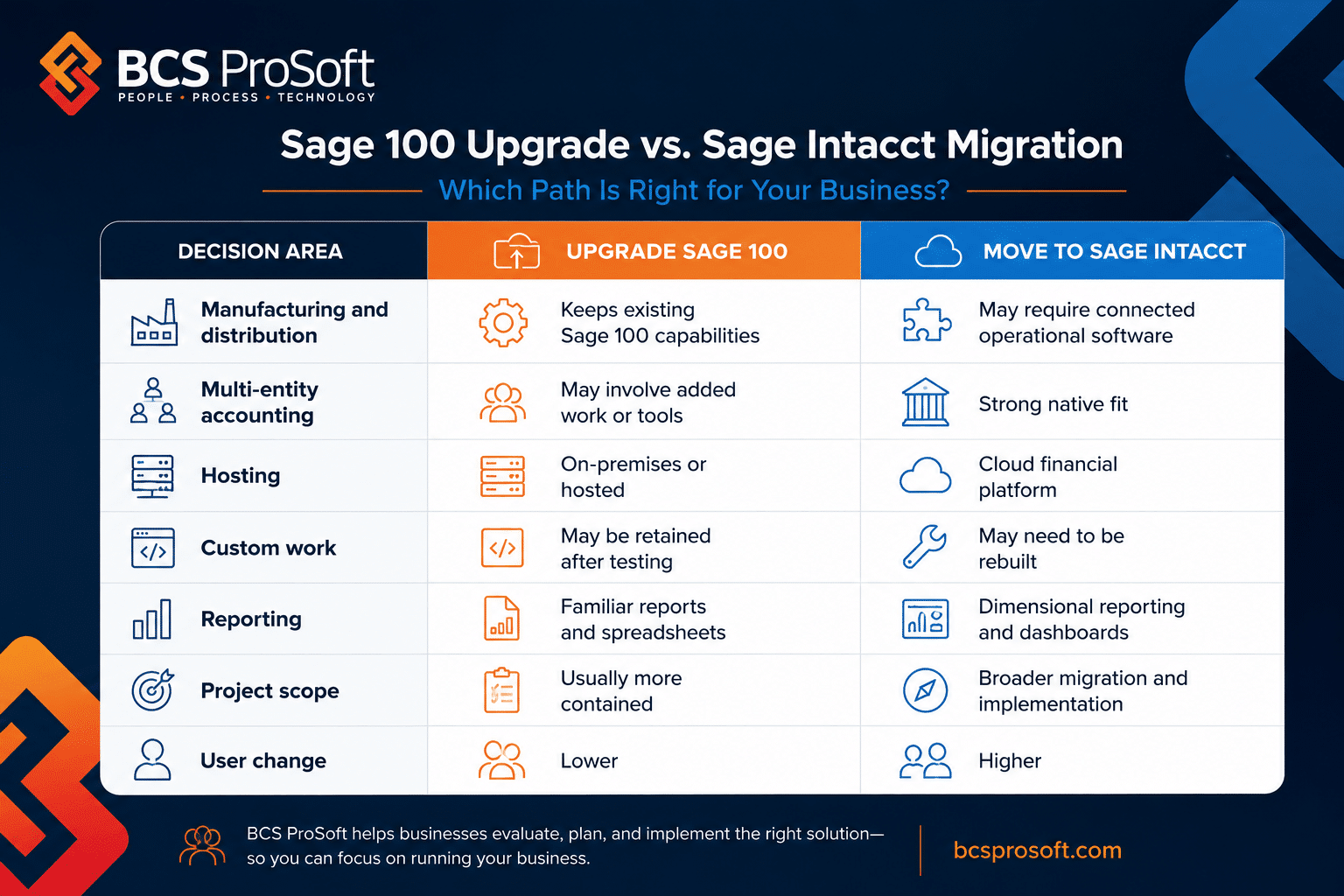
Intacct vs. Sage 100 — Decision Checklist
Use this chart to compare both platforms based on common manufacturing accounting needs:
| Factor | Sage Intacct | Sage 100 |
| Deployment | Cloud SaaS | On-premise or hosted |
| Scalability | Multi-location and multi-entity | Small to mid-sized multi-plant |
| Native manufacturing depth | Requires third-party MRP integrations | Includes production and job costing modules |
| Costing methods | Supports various costing through integrations | Standard, actual, and weighted average |
| Inventory management | Integrated with financials | Strong inventory and production control |
| Reporting | Real-time, dimensional, flexible | Structured reporting with standard formats |
Sage 100 supports hands-on production control and built-in job costing features. Sage Intacct supports dimensional reporting and multi-entity visibility for companies managing broader operations.
Each platform helps manufacturing companies build stronger accounting processes. The right choice depends on how your operations are structured and where your team focuses its day-to-day work.
Conclusion on Accounting for Manufacturing

Manufacturing accounting requires more than a general ledger and a monthly close. It takes systems and processes that reflect the way your production actually runs. When the numbers in your financials match what’s happening on the floor, your team can make better decisions, reduce delays, and spot issues before they impact margin.
That kind of accuracy depends on having the right tools in place. BCS ProSoft works directly with manufacturing companies to help them choose and implement the best-fit system for their environment. Whether you need the flexibility of Sage Intacct or the built-in manufacturing features of Sage 100, our team brings the experience to guide your decision and support you through setup, training, and long-term growth.
If your current system isn’t keeping up, it may be time for a closer look. Reach out to BCS ProSoft to see how the right software and support can move your accounting process closer to the real work your business does every day.
Key Takeaways
- Manufacturing accounting tracks more than income and expenses. It follows the full production flow, including raw materials, labor, overhead, and work-in-progress.
- Common challenges include inventory valuation, job costing, indirect cost allocation, and maintaining accurate records across plants or entities.
- Best practices include maintaining clean BOMs and routings, using a perpetual inventory system, allocating costs with clear drivers, and involving both finance and operations in regular reporting.
- Sage Intacct supports multi-entity reporting, dimensional analysis, and integration with external MRP systems. It works well for finance teams that need centralized visibility across locations.
- Sage 100 includes built-in manufacturing tools like job costing, work orders, MRP, and production tracking. It fits companies that want shop-floor control within a single platform.
Frequently Asked Questions
How is WIP accounted for in a manufacturing P&L?
Work-in-progress (WIP) is recorded as inventory on the balance sheet until the production is complete. Once finished goods are produced, the associated costs, including materials, labor costs, and overhead, move from inventory into the cost of goods sold on the income statement. This treatment follows generally accepted accounting principles and helps ensure the timing of cost recognition aligns with the manufacturing process.
What’s the difference between standard costing and actual costing?
Standard costing uses preset cost estimates for materials, labor, and overhead. Actual costing captures the true costs incurred during production. The difference between the two creates variances, which are analyzed to identify issues or inefficiencies. Businesses choose between these methods based on their production setup, financial management needs, and how closely they monitor cost performance.
Can Sage Intacct handle shop-floor data without a full MRP?
Yes. Sage Intacct supports integrations with manufacturing execution systems (MES) or lightweight production tools. These integrations can feed data such as material usage, production times, and labor costs directly into the accounting system. This setup allows companies to track variable and fixed costs in real time without implementing a full MRP platform.